menu Menu SCOUTING EVERYWHERE search Search
arrow_back Back

Scouting Everywhere

The site is under development. Please bary the UI glitches.

Knife
Thursday, September 1, 2011
 
A knife is perhaps one of the most useful tools you could have at camp. Given enough time, patience and ingenuity most problems can be solved with the safe use of a knife and its application.
READ MORE
Debator
Wednesday, August 31, 2011
Debator
  1. Propose, at least two subjects and oppose at least two others subjects in properly conducted debates.
  2. Participate in debate, in the presence of the examiner for at least five minutes of subject under discussion having prepared the subject thoroughly and submitted concise and orderly notes of his speech.
  3. Know ordinary rules of debate, duties and powers of the chairman.
  4. Know how to chair a debate.
  5. Be able to lead a discussion successfully in a group.
Healthyman
Tuesday, August 30, 2011
Healthyman
  1. Know the importance of the heart, lungs, skin, teeth, feet, stomach and the organs of special sense (eyes, ears and nose) keeping in good order, and principal danger to be guarded against.
  2. Give general rules of governing, eating, drinking, breathing, sleeping, cleanliness and exercise; give evidence of these rules for at least 12 months.
  3. Know the value of fresh air and how to keep rooms ventilated.
  4. Know the dangers incurred in use of tobacco, alcohol, opium and their intoxicating drugs, danger of over straining the body and of continual use of one form of exercise.
  5. Train a patrol in simple exercises suitable for all parts of the body and give reasons for each exercise.
     
Sea Fisherman
Monday, August 29, 2011
Sea Fisherman
  1. Have a practical knowledge of the various methods of catching sea fish for market by means of trawls,nets and lines and catching shell-fish; have practical experience of at least two of these methods.
  2. Be able to describe use of seine or trammel or trawl net and their construction, and make small repairs in a net.
  3. Know usual storm and distress signals.
  4. Know the correct name for usual fish caught in the locality.
Zepplin Bend
Sunday, August 28, 2011
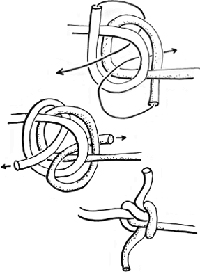
It's perhaps the best way to connect two ropes that there is. It's absolutely secure and jerk-resistant in all materials. It's also remarkably easy to untie after use.
READ MORE
Water Bowline
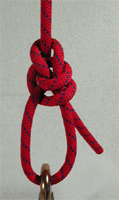
When a rope has to be pulled through water, any knot has a tendency to tighten and jam. In the case of a Bowline, an extra hitch as shown will lessen this tendency.
READ MORE
Weaver's Knot
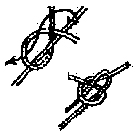
A weaver frequently has to tie knots and many different ones have been used by him. The one shown here is the one most frequently known by this name: it is the Sheet Bend but tied in a special and rapid manner originally peculiar to the weaver.

READ MORE
Wall Knot
A knot worked in the end of a rope with the unlaid strands. Occasionally used on its own as a Rope End Knot but more often as part of a more complex knot, e.g., the Man Rope Knot, etc. It is the exact opposite of a Crown Knot

READ MORE
Turk's Head
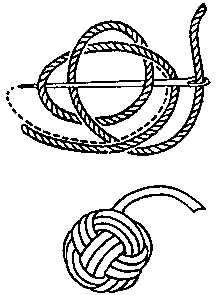
The Turk's Head is, more accurately, a system rather than just a knot, generally tubular in form, decorative and very useful. Basically a binding knot, but can be worked flat for decorative purposes. Can be made with separate strands (Standing Turk's Heads) or with a single, continuous strand (Running Turk's Head).

READ MORE
Tom Fool Knot
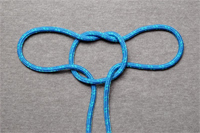
This is sometimes considered as a Handcuff Knot but is somewhat inferior for this purpose to the knot which usually bears that name. It is a good knot with which to commence a slightly fancy Sheepshank. It is also used as a trick knot (it can be tied in a flash in almost a single movement) and is sometimes called the Conjurer's Knot.
READ MORE
share Share linkedin Twitter Facebook Google+