menu Menu SCOUTING EVERYWHERE search Search
arrow_back Back

Scouting Everywhere

The site is under development. Please bary the UI glitches.

Showing posts with label BSA Merit Badges. Show all posts
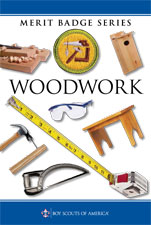
Woodwork
Sunday, March 18, 2012
Wood is an amazingly versatile, practical, yet beautiful material. A skilled craftsman can use wood to fashion just about anything. As a woodworker or carpenter, you will find no end of useful, valuable, and fun items you can make yourself, from wood.

Requirements

  1. Do the following:
    1. Explain to your counselor the most likely hazards you may encounter while participating in woodwork activities, and what you should do to anticipate, help prevent, mitigate, and respond to these hazards. Explain what precautions you should take to safely use your tools.
    2. Show that you know first aid for injuries that could occur while woodworking, including splinters, scratches, cuts, severe bleeding, and shock. Tell what precautions must be taken to help prevent loss of eyesight or hearing, and explain why and when it is necessary to use a dust mask.
    3. Earn the Totin' Chip recognition.
  2. Do the following:
    1. Describe how timber is grown, harvested, and milled. Tell how lumber is cured, seasoned, graded, and sized.
    2. Collect and label blocks of six kinds of wood useful in woodworking. Describe the chief qualities of each. Give the best uses of each.
  3. Do the following:
    1. Show the proper care, use, and storage of all working tools and equipment that you own or use at home or school.
    2. Sharpen correctly the cutting edges of two different tools.
  4. Using a saw, plane, hammer, brace, and bit, make something useful of wood. Cut parts from lumber that you have squared and measured from working drawings.
  5. Create your own carpentry project. List the materials you will need to complete your project, and then build your project. Keep track of the time you spend and the cost of the materials.
  6. Do any TWO of the following:
    1. Make working drawings of a project needing (1) beveled or rounded edges OR curved or incised cuttings, OR (2) miter, dowel, or mortise and tenon joints. Build this project.
    2. Make a cabinet, box, or something else with a door or lid fastened with inset hinges.
    3. Help make and repair wooden toys for underprivileged children OR help carry out a carpentry service project approved by your counselor for a charitable organization.
  7. Talk with a cabinetmaker or carpenter. Find out about the training, apprenticeship, career opportunities, work conditions, work hours, pay rates, and union organization that woodworking experts have in your area.
Resources

Scouting Literature

Drafting, First Aid, Forestry, Home Repairs, Model Design and Building, Painting, Pulp and Paper, and Wood Carving merit badge pamphlets

Books

  • Adkins, Jan. Toolchest. Walker, 1984.
  • Bramlett, Tim. A Kid's Guide to Crafts: Wood Projects. Stackpole Books, 1997.
  • Creative Publishing. The Complete Guide to Easy Woodworking Projects. Creative Publishing, 2003.
  • Fine Woodworking. The Basics of Craftsmanship: Key Advice on Every Aspect of Woodworking. Taunton, 2003.
  • Fraser, Aime. Getting Started in Woodworking: Skill-Building Projects That Teach the Basics. Taunton, 2003.
  • McGuire, Kevin. Woodworking for Kids: 40 Fabulous, Fun & Useful Things for Kids to Make. Sterling, 1994.
  • Nelson, John R. American Folk Toys: Easy-to-Build Toys for Kids of All Ages. Taunton, 1998.

Videos

  • Basic Carpentry. D.I.Y. Video, 1985.
  • Easy Woodworking Projects. D.I.Y. Video, 1985.
  • Small Shop Projects: Boxes. Taunton Press, 1990.
  • Woodworking Made Easy With Hank Metz, Vol. 1: Biscuit Joinery Techniques. Easyway Ventures, 1996.
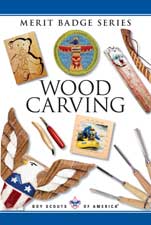
Wood Carving
As with any art, wood carving involves learning the basics of design, along with material selection and tools and techniques, as well as wood-carving safety. The requirements of the Wood Carving merit badge introduce Scouts to an enjoyable hobby and that can become a lifetime activity.

Requirements

  1. Show that you know first aid for injuries or illnesses that could occur while wood carving, including minor cuts and scratches and splinters.
  2. Do the following:
    1. Earn the Totin' Chip recognition.
    2. Discuss with your merit badge counselor your understanding of the Safety Checklist for Carving.
  3. Do the following:
    1. Explain to your counselor, orally or in writing, the care and use of five types of tools that you may use in a carving project.
    2. Tell your counselor how to care for and use several types of sharpening devices, then demonstrate that you know how to use these devices.
  4. Using a piece of scrap wood or a project on which you are working, show your merit badge counselor that you know how to do the following:
    1. Paring cut
    2. Basic cut and push cut
    3. Score line
    4. Stop cut
  5. Tell why different woods are used for different projects. Explain why you chose the type of wood you did for your projects in requirements 6 and 7.
  6. Plan your own or select a project from the Wood Carving merit badge pamphlet and complete a simple carving in the round.
  7. Complete a simple low-relief OR a chip carving project.

Resources

Books

  • Beiderman, Charles, and William Johnston. The Beginner's Handbook of Woodcarving. Dover Publications, 1988.
  • Berry, P. Start a Craft Wood Carving. Book Sales, 1996.
  • Bridgewater, Alan. Carving Totem Poles and Masks: Native American Folk Art. Sterling, 1991.
  • --------. Woodcarving Basics. Sterling, 1996.
  • Green, Larry. First Projects for Wood Carvers: A Pictorial Introduction to Wood Carving. Schiffler, 1996.
  • Guldan, Mary D. The Complete Beginner's Wood Carving Workbook: Ten Ready-to-Use Patterns. Fox Chapel, 1996.
  • Hillyer, John. Woodcarving: 20 Great Projects for Beginners and Weekend Carvers. Lark Books, 2002.
  • Tangerman, Elmer. Carving Animals in Wood. Dover, 1995.
  • --------. Whittling and Woodcarving. Dover Publications, 1962.
  • Toney, Tina. Easy Weekend Carving Projects: A Complete, Illustrated Manual. Fox Chapel, 1996.


Wilderness Survival
In their outdoor activities, Scouts learn to bring the clothing and gear they need, to make good plans, and do their best to manage any risks. But now and then, something unexpected happens. When things go wrong, the skills of wilderness survival can help make everything right again.

Requirements

  1. Show that you know first aid for and how to prevent injuries or illnesses that could occur in backcountry settings, including hypothermia, heat reactions, frostbite, dehydration, blisters, insect stings, tick bites, and snakebites.
  2. From memory, list the seven priorities for survival in a backcountry or wilderness location. Explain the importance of each one with your counselor.
  3. Discuss ways to avoid panic and maintain a high level of morale when lost, and explain why this is important.
  4. Describe the steps you would take to survive in the following conditions:
    1. Cold and snowy
    2. Wet (forest)
    3. Hot and dry (desert)
    4. Windy (mountains or plains)
    5. Water (ocean, lake, or river)
  5. Put together a personal survival kit and explain how each item in it could be useful.
  6. Using three different methods (other than matches), build and light three fires.
  7. Do the following:
    1. Show five different ways to attract attention when lost.
    2. Demonstrate how to use a signal mirror.
    3. Describe from memory five ground-to-air signals and tell what they mean.
  8. Improvise a natural shelter. For the purpose of this demonstration, use techniques that have little negative impact on the environment. Spend a night in your shelter.
  9. Explain how to protect yourself from insects, reptiles, and bears.
  10. Demonstrate three ways to treat water found in the outdoors to prepare it for drinking.
  11. Show that you know the proper clothing to wear in your area on an overnight in extremely hot weather and in extremely cold weather.
  12. Explain why it usually is not wise to eat edible wild plants or wildlife in a wilderness survival situation.

Resources

Scouting Literature

Boy Scout Handbook and Fieldbook; Backpacking, Camping, Canoeing, Emergency Preparedness, First Aid, Lifesaving, Orienteering, Safety, and Weather merit badge pamphlets

Books

  • Angier, Bradford. How to Stay Alive in the Woods. Black Dog and Leventhal Publishers, 2001.
  • Forgey, William W. Basic Essentials: Wilderness First Aid, 3rd ed. Falcon Guides, 2006.
  • Gill, Paul G. Wilderness First Aid. Ragged Mountain Press, 2001.
  • Harvey, Mark. National Outdoor Leadership School's Wilderness Guide: The Classic Handbook. Fireside, 1999.
  • Isaac, Jeffrey. The Outward Bound Wilderness First Aid Handbook. The Lyons Press, 1998.
  • Keller, William. Keller's Outdoor Survival Guide: How to Prevail When Lost, Stranded, or Injured in the Wilderness. Willow Creek Press, 2001.
  • Randall, Glenn. Outward Bound Map and Compass Handbook. The Lyons Press, 1998.
  • Stillwell, Alexander. The Encyclopedia of Survival Techniques. The Lyons Press, 2000.
  • Storm, Rory. The Extreme Survival Guide. Houghton Mifflin, 1999.
  • Tawrell, Paul. Camping and Wilderness Survival. Falcon Distribution, 1996.

Videos

  • More Wilderness 911. DVD. Wellspring Media, 1998.
  • Survival Basics, Vol. 1, and Survival Basics, Vol. 2. DVD. Tapeworm, 2000.
  • The Unexplained—Wilderness Survival. DVD. A&E Home Video, 2001.
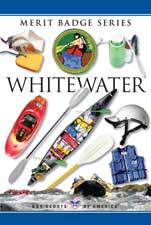
Whitewater
Canoeing or kayaking through whitewater rapids can be a thrilling experience. Safe whitewater fun requires each participant to understand the the equipment and techniques and to have a firm respect for the power of nature's waterways.

Requirements

  1. Do the following:
    1. Review with your counselor the first aid for injuries or illnesses that could occur while working on the Whitewater merit badge, including hypothermia, heat reactions, dehydration, insect stings, blisters, bruises, cuts, and shoulder dislocation.
    2. Identify the conditions that must exist before performing cardiopulmonary resuscitation (CPR) on a person. Explain how such conditions are recognized.
    3. Demonstrate proper technique for performing CPR using a training device approved by your counselor.
  2. Do the following:
    1. Review and compare BSA Safety Afloat and the American Whitewater safety guidelines and demonstrate your understanding of these principles by answering questions from your counselor.
    2. Identify and explain the use and importance of safety equipment on moving water. Include in your explanation a discussion about throw ropes, whistles, and how to choose and properly fit PFDs (personal flotation devices) and helmets.
  3. Before doing requirements 4 through 13, earn the Canoeing merit badge if you will be using a canoe to earn this merit badge. If you will be using a kayak, earn the Kayaking BSA Award.
  4. Do ONE of the following:
    1. If you are completing these requirements as a tandem canoeist, demonstrate basic canoe-handling skills by completing the Scout gate test within 160 seconds while paddling tandem with a buddy. Then demonstrate the following strokes: cross forward, cross draw, bow pry, Duffek, high brace, and low brace.
    2. If you are completing these requirements as a solo canoeist, demonstrate basic solo canoe-handling skills by completing the Scout gate test within 160 seconds. Then demonstrate the following strokes: cross forward, cross draw, stern pry, Duffek, high brace, and low brace.
    3. If you are using a kayak to complete these requirements, demonstrate basic kayak-handling skills by completing the Scout gate test within 160 seconds. Demonstrate the following strokes: Duffek, high brace, low brace, and sculling draw. Then do the following:
      1. Move the kayak forward in a reasonably straight line for 10 yards.
      2. Move the kayak sideways to the right and to the left.
      3. Pivot 360 degrees to the right and left.
      4. Stop the kayak.
  5. Do the following:
    1. Explain the importance of scouting before committing to running a rapid, and discuss good judgment when evaluating a stretch of river or a particular rapid.
    2. Explain the terms downstream V, riffle, strainer, eddy, eddy line, pillow, ledge, bend, shallows, falls, low-head dam, current, rock, drop, horizon line, wave, standing wave, hydraulic, and sleeper.
    3. Explain how to scout and read a river while ashore and while afloat, and discuss the importance of hazard recognition.
    4. Demonstrate your ability to read the river where you are practicing and demonstrating your whitewater skills.
  6. Explain the International Scale of River Difficulty and apply the scale to the stretch of river where you are practicing and demonstrating your whitewater skills. Identify the specific characteristics of the river that are factors in your classification according to the International Scale.
  7. Explain the importance of communication during every whitewater outing. Explain and then demonstrate using the following river signals: "Run right," "Run left," "Run down the center," "Stop," "Are you OK?" and "Help!"
  8. Do the following:
    1. Explain the differences between flatwater and whitewater canoes. Identify the different materials used in modern whitewater canoe construction and the advantages and disadvantages of each.
    2. Describe the various types of kayaks and how they differ in design, materials, and purpose.
    3. Identify the advantages and special uses for kayaks and decked canoes in moving water.
    4. Discuss the construction, safety, and functional features of paddles used in whitewater activities.
  9. Discuss the personal and group equipment necessary for a safe whitewater outing and how and why it is used. Explain how to pack and protect these items.
  10. Wearing the proper personal flotation device (PFD) and being appropriately dressed for the weather and water conditions, perform the following skills in moving water in a properly equipped whitewater craft of your choice (tandem canoe, solo canoe, or solo kayak). If a tandem canoe is used, the skills must be demonstrated from both the bow and stern positions.
    1. Launch and land.
    2. Paddle forward in a straight line.
    3. Backpaddle.
    4. Sideslip, both sides.
    5. Ferry upstream and downstream.
    6. Eddy turn.
    7. Peel out.
  11. Explain and demonstrate:
    1. Self-rescue and procedures when capsized in moving water, including a wet exit if necessary
    2. Safe rescue of others in various whitewater situations using a throw rope
    3. Portaging—when and how to do it
    4. The whitewater buddy system using at least three persons and three craft
  12. Discuss the use of inflatable rafts on moving water. In your discussion, explain the special safety precautions that should be taken when using an inflatable raft and the risks of "tubing" on moving water.
  13. Participate in a whitewater trip using either a canoe or kayak on a Class I or Class II river. Help to prepare a written plan, specifying the route, schedule, equipment, safety precautions, and emergency procedures. Determine local rules and obtain permission from landowners and land managers in advance. Explain what steps you have taken to comply with BSA Safety Afloat and the American Whitewater safety guidelines. Execute the plan with others.

Resources

Scouting Literature

Boy Scout Handbook and Fieldbook; Kayaking BSA Award application; Canoeing, Rowing, and Small-Boat Sailing merit badge pamphlets

Books

  • Bennett, Jeff. The Complete Whitewater Rafter. International Marine/Ragged Mountain Press, 1996.
  • --------. The Essential Whitewater Kayaker. International Marine/ Ragged Mountain Press, 1999.
  • Blaine, Mark. Whitewater: The Thrill and Skill of Running the World's Great Rivers. Black Dog and Leventhal Publishers, 2001.
  • Bechdel, Les. River Rescue: A Manual for Whitewater Safety. Appalachian Mountain Club Books, 1997.
  • Foster, Tom, and Kel Kelly. Catch Every Eddy, Surf Every Wave: A Contemporary Guide to Whitewater Playboating. Outdoor Centre of New England, 1995.
  • Grant, Gordon. Trailside Guide: Canoeing. W. W. Norton & Company, 2003.
  • Harrison, Dave. Canoeing: The Complete Guide to Equipment and Technique. Stackpole Books, 1996.
  • Jackson, Eric. Whitewater Paddling: Strokes & Concepts. Stackpole Books, 1999.
  • Krauzer, Steven M. Trailside Guide: Kayaking. W. W. Norton & Company, 2003.
  • Mason, Bill. Path of the Paddle: An Illustrated Guide to the Art of Canoeing (revised and updated by Paul Mason). Firefly Books, 1999.
  • Mason, Paul. Thrill of the Paddle: The Art of Whitewater Canoeing. Firefly Books, 1999.
  • Nealy, William. Kayak: A Manual of Technique. Menasha Ridge Press, 1986.
  • Ray, Slim. The Canoe Handbook: Techniques for Mastering the Sport of Canoeing. Stackpole Books, 1992.


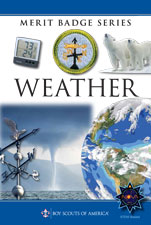
Weather
Meteorology is the study of Earth's atmosphere and its weather and the ways in which temperature, wind, and moisture act together in the environment. In addition to learning how everyday weather is predicted, Scouts can learn about extreme weather such as thunderstorms, tornadoes, and hurricanes, and how to stay safe.

Requirements

  1. Define meteorology. Explain what weather is and what climate is. Discuss how the weather affects farmers, sailors, aviators, and the outdoor construction industry. Tell why weather forecasts are important to each of these groups.
  2. Name five dangerous weather-related conditions. Give the safety rules for each when outdoors and explain the difference between a severe weather watch and a warning. Discuss the safety rules with your family.
  3. Explain the difference between high and low pressure systems in the atmosphere. Tell which is related to good and to poor weather. Draw cross sections of a cold front and a warm front, showing the location and movements of the cold and warm air, the frontal slope, the location and types of clouds associated with each type of front, and the location of precipitation.
  4. Tell what causes wind, why it rains, and how lightning and hail are formed.
  5. Identify and describe clouds in the low, middle, and upper levels of the atmosphere. Relate these to specific types of weather.
  6. Draw a diagram of the water cycle and label its major processes. Explain the water cycle to your counselor.
  7. Define acid rain. Identify which human activities pollute the atmosphere and the effects such pollution can have on people.
  8. Do ONE of the following:
    1. Make one of the following instruments: wind vane, anemometer, rain gauge, hygrometer. Keep a daily weather log for one week using information from this instrument as well as from other sources such as local radio and television stations, NOAA Weather Radio, and Internet sources (with your parent's permission). Record the following information at the same time every day: wind direction and speed, temperature, precipitation, and types of clouds. Be sure to make a note of any morning dew or frost. In the log, also list the weather forecasts from radio or television at the same time each day and show how the weather really turned out.
    2. Visit a National Weather Service office or talk with a local radio or television weathercaster, private meteorologist, local agricultural extension service officer, or university meteorology instructor. Find out what type of weather is most dangerous or damaging to your community. Determine how severe weather and flood warnings reach the homes in your community.
  9. Do ONE of the following:
    1. Give a talk of at least five minutes to a group (such as your unit or a Cub Scout pack) explaining the outdoor safety rules in the event of lightning, flash floods, and tornadoes. Before your talk, share your outline with your counselor for approval.
    2. Read several articles about acid rain and give a prepared talk of at least five minutes to a group (such as your unit or a Cub Scout pack) about the articles. Before your talk, share your outline with your counselor for approval.
  10. Find out about a weather-related career opportunity that interests you. Discuss with and explain to your counselor what training and education are required for such a position, and the responsibilities required of such a position.

Resources

Scouting Literature

Fieldbook; Chemistry, Emergency Preparedness, Environmental Science, and Oceanography merit badge pamphlets

Books

  • Burt, Christopher C. Extreme Weather: A Guide and Record Book. W. W. Norton, 2004.
  • Ceban, Bonnie J. Tornadoes: Disaster and Survival. Enslow Publishers, 2005.
  • Chaston, Peter R. Weather Maps: How to Read and Interpret All the Basic Weather Charts. Chaston Scientific Inc., 2002.
  • Cosgrove, Brian. Weather. DK Publishing, 2004.
  • Day, John. A., and Vincent J. Schaefer. Clouds and Weather: The Concise Field Guide to the Atmosphere. Houghton Mifflin, 1998.
  • Gardner, Robert, et al. Science Projects About Weather. Enslow Publishers, 1994.
  • Elsom, Derek M. Weather Explained: A Beginner's Guide to the Elements, Vol. 5. Henry Holt & Company, 1997.
  • Hodgson, Michael. Basic Essentials: Weather Forecasting. Globe Pequot, 1999.
  • Kahl, Jonathan D. W. National Audubon Society First Field Guide: Weather. Scholastic, 1998.
  • Moran, Joseph M., et al. Meteorology: The Atmosphere and Science of Weather. Prentice Hall, 1996.
  • Petheram, Louise. Acid Rain. Bridgestone Books, 2002.

Magazines

  • Weatherwise: The Magazine About Weather 1319 18th St., NW Washington, DC 20036-1802 Web site: http://www.weather-wise.org
Water Sports
Water sports are a fun and exhilarating way to enjoy being outdoors while developing strength, coordination, and fitness. By developing experience with water sports and practicing good judgment, Scouts will gain skills that will serve them well for a lifetime and have extreme fun while they do.

Requirements

  1. Show that you know first aid for injuries or illnesses that could occur while participating in water sports, including hypothermia, heat exhaustion, heatstroke, dehydration, sunburn, minor cuts and bruises, and blisters.
  2. Do the following:
    1. Identify the conditions that must exist before performing CPR on a person. Explain how such conditions are recognized.
    2. Demonstrate proper technique for performing CPR using a training device approved by your counselor.
  3. Before doing the following requirements, successfully complete the BSA swimmer test.
  4. Do the following:
    1. Discuss the BSA Safety Afloat policy. Tell how it applies to water sports.
    2. Name the different types of personal flotation devices (PFDs), and explain when each type should be used. Show how to choose and properly fit a PFD.
    3. Know the Water Sports Safety Code. Promise that you will live up to it and follow it in all water work for this badge. Know the safety precautions that must be used by the boat operator in pulling water - skiers and wakeboarders.
  5. Show the following skier signals to the safety observer in the boat: skier safe, faster, slower, turns, back to dock, cut motor, skier in water.
  6. Showing reasonable control while using two skis, one ski, or a wakeboard, do EACH of the following:
    1. Show how to enter the water from a boat and make a deepwater start without help.
    2. Show you can cross both wakes four times and return to the center of the wake each time, without falling.
    3. Show you can fall properly to avoid an obstacle. Also show that you can drop handle and coast to a stop without losing your balance.
  7. While on shore, show that you know how to properly adjust the bindings of your ski(s) or wakeboard to fit yourself. Then, in deep water, show you can adjust bindings to fit. Recover and put on your ski(s) or wakeboard that has come off during a fall.

Resources

Scouting Literature

Boy Scout Handbook; Fieldbook; Athletics, First Aid, Lifesaving, Motorboating, Personal Fitness, Small-Boat Sailing, Snow Sports, and Swimming merit badge pamphlets

Books

  • Blomquist, Christopher. Wakeboarding in the X Games. PowerKids Press, 2003.
  • Cooperman, Stephanie. Wakeboarding: Techniques and Tricks. The Rosen Publishing Group Inc., 2003.
  • Duvall, Camille. Camille Duvall's Instructional Guide to Water Skiing. Simon & Schuster, 1992.
  • Favret, Ben, and David Benzel. Complete Guide to Water Skiing. Human Kinetics Publishers, 1997.
  • Firestone, Mary, and Scott N. Atkinson. Extreme Waterskiing Moves. Capstone Press, 2003.
  • Hayhurst, Chris. Wakeboarding! Throw a Tantrum. Saddleback Educational Publishing Inc., 2000.
  • Kalman, Bobbie. Extreme Wakeboarding. Crabtree Publishing Company, 2006.
  • Maurer, Tracy Nelson. Wakeboarding. Rourke Publishing, 2002.
  • Thompson, Luke. Essential Waterskiing for Teens. Children's Press, 2000.
  • Weber, Jason. Wakeboarding: On the Edge. Sports on the Edge LLC, 2000.

Video

  • Higher Education. Bump Films, http://www.bumpfilms.com
Veterinary Medicine
The field of veterinary medicine in the 21st century is one of the most exciting medical professions in which to work. The skills of a veterinarian are practiced with cutting-edge technology and treatment options, and the profession offers a wide range of career choices.

Requirements

  1. Discuss with your counselor the roles a veterinarian plays in the following:
    1. Companion or small animal medicine, and equine medicine
    2. Food animal or large animal medicine
    3. Exotic animal medicine
    4. Marine animal medicine (mammal and fish)
    5. Poultry medicine
    6. Wildlife medicine and aquaculture medicine
  2. Discuss with your counselor the roles a veterinarian plays in the following:
    1. Public health medicine and zoonotic disease surveillance and control
    2. The military
    3. Food safety and inspection
    4. Laboratory animal medicine and research
    5. Teaching and government
  3. Describe the training required to become a veterinarian. Where is the veterinary medical college nearest you? Describe the prerequisites for applying to veterinary school.
  4. Tell your counselor what a registered veterinary technician (R.V.T.) or animal health technician (A.H.T.) is. Describe the training required to become an R.V.T. or A.H.T. Where is the school or facility for R.V.T. or A.H.T. training nearest you? Describe the role an R.V.T. or A.H.T. would play in assisting a veterinarian working in three of the practice types listed in requirement 1.
  5. Discuss with your merit badge counselor the role a veterinarian plays in the human-animal bond.
  6. Do ONE of the following:
    1. Visit a veterinary clinic, hospital, or veterinary referral teaching hospital that does work in one of the practices listed in requirement 1. Spend as much time as you can observing the veterinarians and their staff. Write a report on what you observed and learned at the facility. Share your report with your counselor.
    2. Spend as much time as possible with a veterinarian who works in one of the fields listed in requirement 2. Learn what special training beyond veterinary medical school may have been required for that position. Learn about any special or unusual activities required of this position. Write a report on what you have learned about this field of veterinary medicine. Include in your report how this field serves the needs of the general public. Share your report with your counselor.

Resources

Scouting Literature

Animal Science, Bird Study, Dog Care, Fish and Wildlife Management, Horsemanship, Mammal Study, Nature, Pets, Public Health, and Reptile and Amphibian Study merit badge pamphlets

Books

  • Association of American Veterinary Medical Colleges, et al. Veterinary Medical School Admission Requirements in the United States and Canada. Purdue University Press, 2003.
  • Croke, Vicki, Philip C. Kosch, et al. Animal ER: Extraordinary Stories of Hope and Healing From One of the World's Leading Veterinary Hospitals. Plume, 2000.
  • James Herriot. All Creatures Great and Small. St. Martin's Press, 1998.
  • --------. All Things Bright and Beautiful. St. Martin's Press, 1998.
  • Lee, Mary Price, and Richard S. Lee. Opportunities in Animal and Pet Care Careers. McGraw-Hill/ Contemporary Books, 2001.
  • Maynard, Thane, and Jane Goodall. Working With Wildlife: A Guide to Careers in the Animal World. Orchard Books, 2000.
  • Maze, Stephanie, and Catherine O'Neill Grace. I Want to Be . . . A Veterinarian. Harcourt, 1997.
  • Pavia, Audrey. Careers With Animals. Barrons Educational Series, 2001.


Truck Transportation
Trucking is a large and important industry. No matter where you live, a day is unlikely to go by when you will not see a truck. We use these vehicles to deliver almost every material item we buy. Without trucks, our economy would not work efficiently.

Requirements

  1. List the major truck lines serving your town.
  2. Do the following:
    1. Describe the role of truck transportation within commerce (the movement of goods, funds, and information).
    2. Describe how trucks fit into a company's supply chain. This could be a manufacturer, importer, wholesaler, or retailer.
    3. On paper, map out how goods that are manufactured overseas are transported to a retailer in this country.
  3. Describe the difference between the gasoline engine and the diesel engine that power trucks. List the advantages of each.
  4. Visit a truck terminal and complete items 4a through 4e. After your visit, share what you have learned with your counselor.
    1. Find out what kind of maintenance program the company follows to help keep its fleet, drivers, and the roadway safe.
    2. Find out how dispatchers maintain communication with drivers on the road.
    3. Talk with a professional truck driver about safety. Learn about the truck driver's rules of the road for safe driving. List five safe - driving rules every professional truck driver must follow.
    4. Review the driver's log and find out what kind of information the log contains.
    5. Learn about important federal regulations that help ensure public safety.
  5. Do the following:
    1. Outline the general organization of a trucking company. Describe what each department does.
    2. List five positions with trucking companies and describe each one.
  6. Name five government agencies that work closely with the trucking industry. Describe their role.
  7. List five different kinds of trucks. Tell the service each provides.
  8. Assume that you are going to ship by truck 500 pounds of goods (freight class 65) from your town to another town 500 miles away. Your shipment must arrive within three days. Explain in writing:
    1. How to prepare the shipment
    2. How to compare at least three carriers for time in transit and rates
    3. How to choose which carrier to use
    4. How to insure the shipment for damages
  9. Define the following terms: bill of lading, ETA, logbook, intermodal, containers, tariff, shippers, carrier, consignee, drayage, cartage.
  10. Learn about opportunities in the field of truck transportation. Choose one career in which you are interested and discuss with your counselor the major responsibilities of that position and the qualifications, education, and training such a position requires.

Resources

Scouting Literature

American Business, Auto Mechanics, Aviation, Engineering, Railroading, and Traffic Safety merit badge pamphlets

Books

  • Byrnes, Mike, & Associates. Bumper to Bumper: The Complete Guide to Tractor-Trailer Operations. Mike Byrnes & Associates Inc., 2003.
  • Ouellet, Lawrence J. Pedal to the Metal: The Work Life of Truckers. Temple University Press, 1994.
  • Professional Truck Driver Institute. Trucking: Tractor-Trailer Driver Handbook/Workbook. Delmar Thomas Learning, 1999.
  • Scharnberg, Ken. Opportunities in Trucking Careers. McGraw-Hill, 1999.
  • Woltman, Jeffrey J., and Sheena P. Woltman. Trucking Simplified: Tools and Strategies for Running a Successful Trucking Operation. Boogaloo Press, 2000.


Traffic Safety
Staying safe in traffic wherever you live is getting more difficult all the time, as more and more people take to the road. Earning the Traffic Safety merit badge and will give Scouts some crucial tools to stay safer, when driving a car on a highway, riding a bike across town, or jogging across a busy street.

Requirements

  1. Do the following:
    1. Describe the top 10 mistakes new drivers frequently make. Name the two items you are required by law to carry with you whenever you operate a motor vehicle.
    2. Describe how alcohol and other drugs affect the human body and why a person should never drink and drive, or drive while under the influence of any mind-altering substances including prescription drugs, cold medications, and illicit drugs. For the state where you live, find out what is the legal blood alcohol concentration and the consequences for driving while intoxicated or driving under the influence. Find out what the open-container law is in your state.
    3. Describe at least four factors to be considered in the design of a road or highway. Explain how roadside hazards and road conditions contribute to the occurrence and seriousness of traffic crashes.
    4. Explain why a driver who is fatigued or distracted should not operate a motor vehicle. List five common distractions, explain how driver distractions contribute to traffic accidents, and tell how drivers can minimize distractions. Describe how volunteer drivers can plan to be alert when transporting Scouting participants.
  2. Do the following:
    1. Demonstrate how to properly wear a lap or shoulder belt. Explain why it is important for drivers and passengers to wear safety belts at all times.
    2. List five safety features found in motor vehicles besides occupant restraint systems. Describe each safety feature, how each works, and how each contributes to safety.
  3. Do the following:
    1. Using your family car or another vehicle, demonstrate that all lights and lighting systems in the vehicle are working. Describe the function and explain why each type of light is important to safe driving.
    2. Using your family car or another vehicle, demonstrate how to check tire pressure and identify the correct tire pressure for the vehicle. Explain why proper tire pressure is important to safe driving.
    3. Demonstrate a method to check for adequate tire tread. Explain why proper tire tread is important to safe driving.
    4. Demonstrate with a smear-and-clear test if the windshield wiper blades will clear the windshield completely or need to be replaced. Describe instances in good and bad weather when windshield washers are important to safe driving.
  4. Do the following:
    1. In a location away from traffic hazards, measure with a tape measure - not in a car—and mark off with stakes the distance that a car will travel during the time needed for decision and reaction, and the braking distances necessary to stop a car traveling 30, 50, and 70 miles per hour on dry, level pavement. Discuss how environmental factors such as bad weather and road conditions will affect the distance.
    2. Demonstrate the difference in nighttime visibility between a properly lit bicycle and rider (or a pedestrian) wearing reflective material and a bicycle and rider with no lights (or a pedestrian) dressed in dark clothing, without reflective material.
    3. Explain how color and shape are used to help road users recognize and understand the information presented on traffic and roadway signs. Explain the purpose of different types of signs, signals, and pavement markings.
    4. Describe at least three examples of traffic laws that apply to drivers of motor vehicles and that bicyclists must also obey.
  5. Do ONE of the following:
    1. Interview a traffic law enforcement officer in your community to identify what three traffic safety problems the officer is most concerned about. Discuss with your merit badge counselor possible ways to solve one of those problems.
    2. Using the Internet (with your parent’s permission), visit five Web sites that cover safe driving for teenagers. As a group, discuss what you learn with your counselor and at least three other teenagers.
    3. Initiate and organize an activity or event to demonstrate the importance of traffic safety.
    4. Accompanied by an adult and a buddy, pick a safe place to observe traffic at a controlled intersection (traffic signal or stop sign) on three separate days and at three different times of the day, for 30 minutes on each visit. At this intersection, survey
      1. such violations as running a red light or stop sign; or (2) seat belt usage. Count the number of violations or number of drivers not wearing a seat belt. Record in general terms if the driver was young or old, male or female. Keep track of the total number of vehicles observed so that you can determine the percentage of compliance vs. violations. Discuss your findings with your merit badge counselor.

Resources

Scouting Literature

Auto Mechanics, Citizenship in the Community, Cycling, Emergency Preparedness, Engineering, First Aid, Railroading, Safety, and Truck Transportation merit badge pamphlets

Books

  • Aaseng, Nathan. Teens and Drunk Driving. Lucent Books, 2000.
  • Alliance for Safe Driving. License to Drive. Delmar, 1999.
  • Berardelli, Phil. Safe Young Drivers: A Guide for Parents and Teens. Nautilus Communications, 1998.
  • Boelts, Maribeth. A Kid's Guide to Staying Safe on Bikes. Powerkids Press, 1998.
  • Booley, Theresa Anne. Alcohol and Your Liver: The Incredibly Disgusting Story. Rosen, 2000.
  • Burke, Edmund R. Serious Cycling. Human Kinetics, 2002.
  • Carr, Woodii. The ABCs of Driving. Integrated International Systems, 1998.
  • Ditchfield, Christin. Cycling. Children's Press, 2000.
  • Gerdes, Louise I. Drunk Driving. Greenhaven Press, 2001.
  • Hewitt, Ben. New Cyclist's Handbook. Rodale Inc., 2005.
  • James, Leon, and Diane Nahl. Road Rage and Aggressive Driving: Steering Clear of Highway Warfare. Prometheus Books, 2000.
  • Johnson, Margaret; Owen Crabb; Arthur Opfer; and Ronald Budig. Drive Right, 10th ed. Scott Foresman Addison Wesley, 2000.
  • Knox, Jean McBee. Drinking, Driving, and Drugs. Chelsea House, 1998.
  • Pavelka, Ed, and Editors of Bicycling Magazine. Bicycling Magazine's Complete Book of Road Cycling Skills. Rodale Inc., 1998.
  • Pease, Robert A. How to Drive Into Accidents and How Not To. Pease Publishing, 1998.
  • Wallace, Roy M., and Bill Katovsky. Bike for Life. Marlowe & Co., 2005.
Theater
While earning the Theater merit badge, Scouts will learn to appreciate live performances as members of the audience as well as go behind the footlights to see the view from the other side. Much more goes on in theater than ever meets the audience's eye.

Requirements

  1. See or read three full-length plays or scripts. These can be from the stage, movies, television, or video. Write a review of each. Comment on the story, acting, and staging.
  2. Write a one-act play that will take at least eight minutes to perform. The play must have a main character, conflict, and a climax.
  3. Do THREE of the following:
    1. Act a major part in a full-length play; or, act a part in three one-act plays.
    2. Direct a play. Cast, rehearse, and stage it. The play must be at least 10 minutes long.
    3. Design the set for a play or a production of a circus. Make a model of it.
    4. Design the costumes for five characters in one play set in a time before 1900.
    5. Show skill in stage makeup. Make up yourself or a friend as an old man, a clown, an extraterrestrial, or a monster as directed.
    6. Help with the building of scenery for one full-length play or two one-act plays.
    7. Design the lighting for a play; or, under guidance, handle the lighting for a play.
  4. Mime or pantomime any ONE of the following, chosen by your counselor.
    1. You have come into a large room. It is full of pictures, furniture, and other things of interest.
    2. As you are getting on a bus, your books fall into a puddle. By the time you pick them up, the bus has driven off.
    3. You have failed a school test. You are talking with your teacher, who does not buy your story.
    4. You are at camp with a new Scout. You try to help him pass a cooking test. He learns very slowly.
    5. You are at a banquet. The meat is good. You don’t like the vegetable. The dessert is ice cream.
    6. You are a circus performer such as a juggler, high-wire artist, or lion tamer doing a routine.
  5. Explain the following: proscenium arch, central or arena staging, spotlight, floodlight, flies, center stage, stage right, stage left, stage brace, stage crew, cyclorama, portal, sound board.
  6. Do two short entertainment features that you could present either alone or with others for a troop meeting or campfire.

Resources

Scouting Literature

Art, Cinematography, Communications, Journalism, Model Design and Building, Painting, and Reading merit badge pamphlets.

Books

  • Aitken, Maria. Style: Acting in High Comedy. Applause, 1996.
  • Bloom, Michael. Thinking Like a Director: A Practical Handbook. Faber & Faber, 2001.
  • Brown, John Russell, ed. The Oxford Illustrated History of Theatre. Oxford Press, 2001.
  • Bruder, Melissa. A Practical Handbook for the Actor. Vintage Books, 1986.
  • Campbell, Drew. Technical Theater for Nontechnical People. Allworth Press, 1999.
  • Carter, Paul. The Backstage Handbook: An Illustrated Almanac of Technical Information, 3rd ed. Broadway Press, 1994.
  • Catron, Louis E. The Elements of Playwriting. Waveland Press, 2001.
  • Clurman, Harold. On Directing. Touchstone Books, 1997.
  • Cohen, Edward M. Working on a New Play. Limelight Editions, 1995.
  • Corson, Richard. Stage Makeup, 9th ed. Pearson Allyn & Bacon, 2000.
  • Covey, Liz, and Rosemary Ingham. The Costume Designer's Handbook, 2nd ed. Heinemann, 1992.
  • Fraser, Neil. Stage Lighting Explained. Crowood Press, 2002.
  • Gillette, J. Michael. Theatrical Design and Production: An Introduction to Scene Design and Construction, Lighting, Sound, Costume, and Makeup. McGraw-Hill, 1999.
  • Kipnis, Claude. The Mime Book. Meriwether Publishing, 1990.
  • Korty, Carol. Writing Your Own Plays: Creating, Adapting, Improvising. Players Press, 2000.
  • Novelly, Maria C. Theatre Games for Young Performers: Improvisations and Exercises for Developing Acting Skills. Meriwether Publishing, 1985.
  • Pecktal, Lynn. Designing and Drawing for the Theatre. McGraw-Hill, 1994.
  • Pennington, Lee. The Actor's Edge. Marble Falls Press, 1996.
  • Peterson, Lenka; Dan O'Connor, and Robert Coles. Kids Take the Stage: Helping Young People Discover the Creative Outlet of Theater. Back Stage Books, 1997.
  • Smith, Ronn, and Ming Cho Lee. American Set Design Two. Theatre Communications Group, 1991.
  • Swinfield, Rosemarie. Stage Makeup Step-By-Step. Betterway Publications, 1995.
  • Walters, Graham. Stage Lighting Step-by-Step: The Complete Guide on Setting the Stage With Light to Get Dramatic Results. Writer's Digest Books, 1997.
  • Yager, Fred, and Jan Yager. Career Opportunities in the Film Industry. Facts on File, 2003.
Textile
People use countless fibers and fabrics in their everyday lives: clothes, carpets, curtains, towels, sheets, upholstered furniture. Add to that list boat sails, book bindings, bandages, flags, sleeping bags, mailbags, airbags, seat belts, backpacks, parachutes, umbrellas, basketball nets, and more.

Requirements

  1. Discuss with your merit badge counselor the importance of textiles. In your discussion, define the terms fiber, fabric, and textile. Give examples of textiles you use every day.
  2. Do the following:
    1. Get swatches of two natural-fiber fabrics (100 percent cotton, linen, wool, or silk; no blends). Get swatches of two synthetic-fiber fabrics (nylon, polyester, acrylic, olefin, or spandex). Get a sample of one cellulosic fabric (rayon, acetate, or lyocell).
    2. Give the origin, major characteristics, and general content of each type of fiber obtained for 2a. Explain the difference between a cellulosic manufactured fiber and a synthetic manufactured fiber.
    3. Describe the main steps in making raw fiber into yarn, and yarn into fabric.
    4. Assume you will soon buy a new garment or other textile item. Tell your counselor what fiber or blend of fibers you want the item to be, and give reasons for your choice.
  3. Do TWO of the following:
    1. Visit a textile plant, textile products manufacturer, or textile school or college. Report on what you saw and learned.
    2. Weave a belt, headband, place mat, or wall hanging. Use a simple loom that you have made yourself.
    3. With a magnifying glass, examine a woven fabric, a nonwoven fabric, and a knitted fabric. Sketch what you see. Explain how the three constructions are different.
    4. Make a piece of felt.
    5. Make two natural dyes and use them to dye a garment or a piece of fabric.
    6. Waterproof a fabric.
    7. Demonstrate how to identify fibers, using microscope identification or the breaking test.
  4. Explain the meaning of 10 of the following terms: warp, harness, heddle, shed, aramid, spandex, sliver, yarn, spindle, distaff, loom, cellulose, sericulture, extrusion, carbon fibers, spinneret, staple, worsted, nonwoven, greige goods.
  5. List the advantages and disadvantages of natural plant fibers, natural animal fibers, cellulosic manufactured fibers, and synthetic manufactured fibers. Identify and discuss at least four ecological concerns regarding the production and care of textiles.
  6. Explain to your merit badge counselor, either verbally or in a written report, five career possibilities in the textile industry. Tell about two positions that interest you the most and the education, cost of training, and specific duties those positions require.

Resources

Scouting Literature

American Business, Animal Science, Art, Basketry, Chemistry, Energy, Environmental Science, Graphic Arts, Indian Lore, Insect Study, and Plant Science merit badge pamphlets

Books

  • Barber, Elizabeth Wayland. The Mummies of Ueruemchi. W.W. Norton, 1999.
  • Brown, Rachel. The Weaving, Spinning, and Dyeing Book. Knopf, 1983.
  • Burningham, Veronica. Weaving Without a Loom. Search Press, 1998.
  • Crolius, Kendall, and Anne Montgomery. Knitting With Dog Hair. St. Martin's, 1997.
  • Dean, Jenny. Wild Color. Watson-Guptill, 1999.
  • Delaney, Connie. Spindle Spinning: From Novice to Expert. Kokovoko Press, 1998.
  • Doney, Meryl. Textiles. Franklin Watts, 1998.
  • Garfield, Simon. Mauve: How One Man Invented a Color That Changed the World. W.W. Norton, 2001.
  • Johnson, Sylvia A. Silkworms. First Avenue Editions, 1989.
  • Joseph, Marjory L., et al. Joseph's Introductory Textile Science. Sixth edition. Holt, Rinehart and Winston, 1992.
  • Keeler, Patricia A., and Francis X. McCall Jr. Unraveling Fibers. Atheneum, 1995.
  • Macaulay, David. Mill. Houghton Mifflin, 1989.
  • McGrayne, Sharon Bertsch. Blue Genes and Polyester Plants: 365 More Surprising Scientific Facts, Breakthroughs, and Discoveries. John Wiley and Sons, 1997.
  • O'Reilly, Susie. Textiles. Bookwright, 1991.
  • Parker, Steve. Textiles. Gareth Stevens, 2002.
  • Simonds, Christopher. Samuel Slater's Mill and the Industrial Revolution. Silver Burdett Press, 1990.
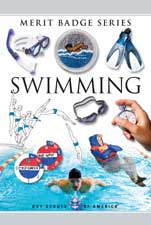
Swimming
Swimming is a leisure activity, a competitive sport, and a basic survival skill. Scouts who earn this badge will learn about safety when swimming and diving, how swimming can contribute to overall fitness and health, and gain some basic competitive swimming skills.

Requirements

  1. Discuss the prevention of and treatment for health concerns that could occur while swimming, including hypothermia, dehydration, sunburn, heat exhaustion, heatstroke, muscle cramps, hyperventilation, spinal injury, stings and bites, and cuts and scrapes.
  2. Do the following:
    1. Identify the conditions that must exist before performing CPR on a person. Explain how to recognize such conditions.
    2. Demonstrate proper technique for performing CPR using a training device approved by your counselor.
  3. Before doing the following requirements, successfully complete Second Class rank requirements 8a through 8c and First Class rank requirements 9a through 9c.
  4. Second Class rank requirements 8a through 8c:
    (8a) Tell what precautions must be taken for a safe swim.
    (8b) Demonstrate your ability to jump feetfirst into water over your head in depth, level off and swim 25 feet on the surface, stop, turn sharply, resume swimming, then return to your starting place.
    (8c) Demonstrate water rescue methods by reaching with your arm or leg, by reaching with a suitable object, and by throwing lines and objects. Explain why swimming rescues should not be attempted when a reaching or throwing rescue is possible, and explain why and how a rescue swimmer should avoid contact with the victim.
    First Class rank requirements 9a through 9c:
    (9a) Tell what precautions must be taken for a safe trip afloat.
    (9b) Before doing the following requirement, successfully complete the BSA swimmer test: Jump feetfirst into water over your head in depth, swim 75 yards in a strong manner using one or more of the following strokes: sidestroke, breaststroke, trudgen, or crawl; then swim 25 yards using an easy, resting backstroke. The 100 yards must be swum continuously and include at least one sharp turn. After completing the swim, rest by floating.
    (9c) With a helper and a practice victim, show a line rescue both as tender and as rescuer. The practice victim should be approximately 30 feet from shore in deep water.
  5. Demonstrate survival skills by jumping feetfirst into deep water wearing clothes (shoes, socks, swim trunks, long pants, belt, and long-sleeved shirt). Remove shoes and socks, inflate the shirt, and show that you can float using the shirt for support. Remove and inflate the pants. Swim 50 feet using the inflated pants for support, then show how to reinflate the pants while still afloat.
  6. Swim continuously for 150 yards using the following strokes in good form and in a strong manner: front crawl or trudgen for 25 yards, back crawl for 25 yards, sidestroke for 25 yards, breaststroke for 25 yards, and elementary backstroke for 50 yards.
  7. Do the following:
    1. Float faceup in a resting position for at least one minute.
    2. Demonstrate survival floating for at least five minutes.
    3. While wearing a properly fitted personal flotation device (PFD), demonstrate the HELP and huddle positions. Explain their purposes.
    4. Explain why swimming or survival floating will hasten the onset of hypothermia in cold water.
  8. In water over your head, but not to exceed 10 feet, do each of the following:
    1. Use the feetfirst method of surface diving and bring an object up from the bottom.
    2. Do a headfirst surface dive (pike or tuck), and bring the object up again.
    3. Do a headfirst surface dive to a depth of at least 5 feet and swim underwater for three strokes. Come to the surface, take a breath, and repeat the sequence twice.
  9. Do ONE of the following:
    1. Demonstrate snorkeling and scuba diving knowledge:
      1. Demonstrate selection and fit of mask, snorkel, and fins; discuss safety in both pool and open-water snorkeling.
      2. Demonstrate proper use of mask, snorkel, and fins for underwater search and rescue.
      3. Describe the sport of scuba diving or snorkeling, and demonstrate your knowledge of BSA policies and procedures relating to that sport.
      OR
    2. Demonstrate the following competitive swimming skills:
      1. Racing dive from a pool edge or dock edge (no elevated dives from racing platforms or starting blocks)
      2. Racing form for 25 yards on one competitive stroke (front crawl, back crawl, breaststroke, or butterfly)
      3. Racing turns for the stroke that you chose in 8b(2), OR, if the camp facilities cannot accommodate the racing turn, repeat 8b(2) with an additional stroke.
      4. Describe the sport of competitive swimming.
  10. Following the guidelines set in the BSA Safe Swim Defense, in water at least 7 feet deep, show a standing headfirst dive from a dock or pool deck. Show a long shallow dive, also from the dock or pool deck.
  11. Do the following:
    1. Explain the health benefits of regular aerobic exercise, and explain why many people today do not get enough of the beneficial kinds of exercise.
    2. Discuss why swimming is favored as both a fitness and a therapeutic exercise.
    3. Write a plan for a swimming exercise program that will promote aerobic/vascular fitness, strength and muscle tone, body flexibility, and weight control for a person of Scout age. Identify resources and facilities available in your home community that would be needed for such a program.
    4. Discuss with your counselor the incentives and obstacles for staying with the fitness program you identified in requirement 10c. Explain the unique benefits that could be gained from this program, and discuss how personal health awareness and self-discipline would relate to your own willingness and ability to pursue such a program.

Resources

Books

  • American Red Cross, Swimming and Diving, 1992.
  • Guzman, Ruben J. Swimming Drills for Every Stroke. Human Kinetics Publishers, 1998.
  • Hines, Emmett W. Fitness Swimming. Human Kinetics Publishers, 1998.
  • Laughlin, Terry. Total Immersion: The Revolutionary Way to Swim Better, Faster, and Easier. Simon & Schuster, 1996.
  • Page, Jason. Swimming: Sprints, Medleys, Diving, Water Polo, and Lots, Lots More. Lerner Publishing Group, 2000.
  • Peterson, Sue. H. Swim With Me: A New Fun Approach to Learning to Swim. Tricycle Press, 1999.
  • Tarpinian, Steve. The Essential Swimmer. Lyons Press, 1995.
  • Thomas, David G. Swimming: Steps to Success. Human Kinetics Publishers, 1996.
  • Whitten, Phillip. The Complete Book of Swimming. Random House, 1993.


Snow Sports
Skiing and snowboarding are the fastest and most thrilling ways to travel on foot in snow country. These sports also provide the physical benefits of fresh air, rhythmic action, and strenuous exercise. Many games and contests give snow sports variety and added rewards.

Requirements

  1. Discuss winter sports safety, and show that you know first aid for injuries or illnesses that could occur while skiing or riding, including hypothermia, frostbite, shock, dehydration, sunburn, fractures, bruises, sprains, and strains. Tell how to apply splints.
  2. Explain why every skier or snowboarder should be prepared to render first aid in the event of an accident.
  3. Explain the procedure used to report an accident to the local ski patrol for the area where you usually ski or ride.
  4. Do EACH of the following:
    1. Tell the meaning of the Your Responsibility Code for skiers and snowboarders. Explain why each rider must follow this code.
    2. Explain the Smart Style safety program. Tell why it is important and how it applies to skiers and snowboarders in terrain parks and pipes.
    3. Explain the precautions pertaining to avalanche safety, including the responsibility of individuals regarding avalanche safety.
    4. Tell the meaning of the Wilderness Use Policy. Explain why each skier and snowboarder must adopt this policy.
  5. Complete all of the requirements for ONE of the following options: downhill (Alpine) skiing or cross-country (Nordic) or snowboarding.
Downhill (Alpine) Skiing Option
  1. Show how to use and maintain your own release bindings and explain the use of two others. Explain the international DIN standard and what it means to skiers.
  2. Explain the American Teaching System and a basic snow-skiing progression.
  3. Name the major ski organizations in the United States and explain their functions.
  4. Discuss the five types of Alpine skis. Demonstrate two ways to carry skis and poles safely and easily.
  5. Explain the importance of strength, endurance, and flexibility in downhill skiing. Demonstrate exercises and activities you can do to get fit for skiing.
  6. Present yourself properly clothed and equipped for downhill skiing. Discuss how the clothing you have chosen will keep you warm and protected.
  7. Demonstrate how to ride one kind of lift and explain how to ride two others.
  8. Explain the international trail-marking system.
  9. On a gentle slope, demonstrate some of the beginning maneuvers learned in skiing. Include the straight run, gliding wedge, wedge stop, sidestep, and herringbone maneuvers.
  10. On slightly steeper terrain, show linked wedge turns.
  11. On a moderate slope, demonstrate five to 10 christies.
  12. Make a controlled run down an intermediate slope and demonstrate the following:
    1. Short-, medium-, and long-radius parallel turns
    2. A sideslip and safety (hockey) stop to each side
    3. Traverse across a slope
  13. Demonstrate the ability to ski in varied conditions, including changes in pitch, snow conditions, and moguls. Maintain your balance and ability to turn.
Cross-Country (Nordic) Skiing Option
  1. Show your ability to select, use, and repair, if necessary, the correct equipment for ski touring in safety and comfort.
  2. Discuss classical and telemark skis. Demonstrate two ways to carry skis safely and easily.
  3. Discuss the basic principles of waxing for cross-country ski touring.
  4. Discuss the differences between cross-country skiing, ski touring, ski mountaineering, and downhill skiing.
  5. Explain the importance of strength, endurance, and flexibility in cross-country skiing. Demonstrate exercises and activities you can do to get fit for skiing.
  6. List items you would take on a one-day ski tour.
  7. Present yourself properly clothed and equipped for a one-day ski tour. Discuss the correct use of your clothing and equipment, and how the clothing you have chosen will keep you warm and protected.
  8. Demonstrate the proper use of a topographic map and compass.
  9. Show a degree of stamina that will enable you to keep up with an average ski-touring group your age.
  10. On a gentle, packed slope, show some basic ways to control speed and direction. Include the straight run, traverse, sideslip, step turn, wedge stop, and wedge turn maneuvers.
  11. On a cross-country trail, demonstrate effective propulsion by showing proper weight transfer from ski to ski, pole timing, rhythm, flow, and glide.
  12. Demonstrate your ability, on a tour, to cope with an average variety of snow conditions.
  13. Demonstrate several methods of dealing with steep hills or difficult conditions. Include traverses and kick turns going uphill and downhill, sidesteps, pole drag, and ski-pole "glissade."
Snowboarding Option
  1. Discuss forward-fall injuries. Tell about prevention and what action must be taken in the event of any type of injury or accident.
  2. Do the following:
    1. Demonstrate your ability to select the correct equipment for snowboarding and to use it for safety and comfort.
    2. Present yourself properly clothed and equipped for snowboarding. Discuss how the clothing you have chosen will keep you warm and protected.
  3. Show how to use and maintain your own bindings, and explain the use of the different binding methods. Explain the need for leashes.
  4. Discuss the four types of snowboards. Demonstrate how to carry a snowboard easily and safely.
  5. Demonstrate exercises and activities that will get you fit for snowboarding.
  6. Demonstrate how to ride one kind of lift and explain how to ride two others.
  7. Explain the international trail-marking system.
  8. Demonstrate the basic principles of waxing a snowboard.
  9. Do the following:
    1. On a gentle slope, demonstrate beginning snowboarding maneuvers. Show basic ways to control speed and direction. Include the sideslipping maneuver.
    2. On slightly steeper terrain, show traversing.
    3. On a moderate slope, demonstrate an ollie, a nose-end grab, and a wheelie.
  10. Make a controlled run down an intermediate slope and demonstrate the following:
    1. Skidded, carved, and jump turns
    2. Stops
    3. Riding fakie
  11. Demonstrate your ability to ride in varied conditions, including changes in pitch, snow conditions, and moguls. Maintain your balance and ability to turn.
  12. Name the major snowboarding organizations in the United States and explain their functions.

Resources

Scouting Literature

Emergency Preparedness, First Aid, Orienteering, Personal Fitness, and Wilderness Survival merit badge pamphlets

Books

Downhill Skiing
  • Bartelski, Konrad, and Robin Neillands. Learn Downhill Skiing in a Weekend. Knopf, 1992.
  • Gordon, Herb. Essential Skiing: A Bible for Beginning Skiers. Lyons & Burford, 1996.
  • McCallum, Paul, and Christine Lariviere McCallum. The Downhill Skiing Handbook. Betterway, 1992.
  • Petrick, Tim. Sports Illustrated Skiing: Six Ways to Reach Your Skiing Potential. Sports Illustrated, 1989.
  • Shedden, John. Skiing. Stackpole, 1996.
Cross-Country Skiing
  • Cook, Charles. The Essential Guide to Cross-Country Skiing & Snow-Shoeing in the United States. Henry Holt, 1997.
  • Endestad, Audun, and John Teaford. Skating for Cross-Country Skiers. Leisure Press, 1987.
  • English, Brad. Total Telemarking. East River Publishing, 1984.
  • Gullion, Laurie. The Cross-Country Primer. Lyons & Burford, 1990.
  • Mansfield, Dick. Skating on Skis. Acorn, 1990.
  • Moynier, John, and Li Newton. The Basic Essentials of Cross-Country Skiing. ICS, 1990.
  • Wicks, David. Making Tracks: An Introduction to Cross-Country Skiing. Pruett, 1995.
Snowboarding
  • Althen, K. C. The Complete Book of Snowboarding. Charles E. Tuttle, 1990.
  • Bennett, Jeff, and Scott Downey. The Complete Snowboarder. McGraw-Hill, 1994.
  • Howe, Susanna. A Cultural History of Snowboarding. St. Martin's Press, 1998.
  • Jensen, Julie. Beginning Snowboarding. Lerner, 1996.
  • McMullen, John. The Basic Essentials of Snowboarding. ICS, 1991.
  • Reichenfeld, Rob, and Anna Bruechert. Snow-Boarding. Human Kinetics Inc., 1995.
  • Sullivan, George. Snowboarding: A Complete Guide for Beginners. Cobblehill, 1997.
  • Weiss, Christof. Snowboarding Know-How. Sterling, 1993.
Small-Boat Sailing
Sailing is one of the most enjoyable pastimes on the open water. The quiet and peacefulness of the water can provide a pleasant break from everyday life. However, smooth sailing requires paying careful attention to safety.

Requirements

  1. Do the following:
    1. Explain first aid for injuries or illnesses that could occur while small-boat sailing, including hypothermia, dehydration, heat reactions, motion sickness, cuts, scratches, abrasions, contusions, puncture wounds, and blisters.
    2. Identify the conditions that must exist before performing CPR on a person, and explain how to recognize such conditions. Demonstrate proper technique for performing CPR using a training device approved by your counselor.
  2. Before doing the following requirements, successfully complete the BSA swimmer test.
  3. Describe the boat you will be using for the sailing requirement, naming all of the major parts and the function of those parts.*
  4. Before going afloat, do the following:
    1. Discuss the nine points of the BSA Safety Afloat plan.
    2. Explain the rules of the road in general and any specific rules or laws that apply to your area or state.
    3. Explain how water conditions, the hazards of weather, and heavy winds can affect both safety and performance in sailing.
    4. Discuss the warning signs of inclement weather and what to do should heavy winds develop or a storm approach.
    5. Prepare a typical float plan.
    6. Discuss the proper clothing, footwear, and personal gear required for small-boat sailing in warm weather and in cool weather. Explain how choosing the proper clothing, footwear, and personal gear will help keep you comfortable and safe while sailing.
  5. Discuss with your counselor how to identify the wind direction and wind indicators. Explain the importance of this task before setting sail.
  6. Following the BSA Safety Afloat plan, show that you and a buddy can sail a boat properly. Do the following:
    1. Prepare a boat for sailing, including a safety inspection.
    2. Get underway from a dock, mooring, or beach.
    3. Properly set sails for a round-trip course approved by your counselor that will include running, beating, and reaching--the basic points of sail. While sailing, demonstrate good helmsmanship skills.
    4. Change direction by tacking; change direction by jibing.
    5. Demonstrate getting out of irons.
    6. Demonstrate the safety position.
    7. Demonstrate capsize procedures and the rescue of a person overboard.**
    8. Demonstrate the procedure to take after running aground.
    9. Upon returning to the dock, mooring, or beach, properly secure all equipment, furl or stow sails, and prepare the craft for unattended docking or beaching overnight or longer.
  7. Demonstrate a working knowledge of marlinespike seamanship. Do the following:
    1. Show how to tie a square (reef) knot, clove hitch, two half hitches, bowline, cleat hitch, and figure-eight knot. Demonstrate the use of each.
    2. Show how to heave a line, coil a line, and fake down a line.
    3. Discuss the kinds of lines used on sailboats and the types of fibers used in their manufacture. Explain the advantages and disadvantages of each.
  8. Describe how you would care for and maintain a sailboat and its gear throughout the year.
  9. With your counselor, review sailing terminology and the points of sail. Discuss various types of sailboats in use today and explain their differences
* The skills may be demonstrated on any boat available to the Scout; sailboards are not acceptable. While no specific sail plan is recommended, it is suggested that the craft be smaller than 20 feet. The boat must be capsizable and have the capability of sailing to windward.
** Capsize procedures should be conducted under the close supervision of the counselor. A rescue boat should be standing by to assist, if necessary, and to tow the capsized craft to shore. Self-bailing boats are acceptable for this requirement. Extreme care should be taken to avoid personal injury and damage to the boat or equipment.

Resources

Scouting Literature

Fieldbook; Sea Scout Manual; Canoeing, Motorboating, Rowing, and Whitewater merit badge pamphlets

Books

  • Ashley, Clifford. Ashley Book of Knots. Doubleday, 1944.
  • Bond, Bob. The Handbook of Sailing. Knopf, 1992.
  • Fries, Derrick. Start Sailing Right! US Sailing Association, 1997.
  • Isler, Peter, and J. J. Isler. Sailing for Dummies. IDG Books Worldwide, 1997.
  • Kantor, John. Basic Sailing. Longshore Sailing School (customerservice@ LongshoreSailingSchool.com), 2004.
  • Maloney, Elbert S. Chapman Piloting and Seamanship. Hearst Corporation, 2003.
  • Rousmaniere, John. Annapolis Book of Seamanship. Simon & Schuster, 1999.
  • Royce, Patrick. Royce's Sailing Illustrated. Royce Publications, 1997.
  • Smith, Hervey Garrett. The Marlinspike Sailor. International Marine/Ragged Mountain Press, 1993.
  • US Sailing Association. Small Boat Sailor Certification Record Book ("The Little Red Book"). US Sailing Association, 2001.
Skating

This merit badge introduces Scouts to the exciting world of ice skating, roller skating, and in-line skating. In addition to being an enjoyable leisure activity that promotes fitness, there are a variety of athletic careers in skating.

Requirements

  1. Show that you know first aid for injuries or illnesses that may occur while skating, including hypothermia, frostbite, lacerations, abrasions, fractures, sprains and strains, blisters, heat reactions, shock, and cardiac arrest.
  2. Complete ALL of the requirements for ONE of the following options.
Ice Skating Option
  1. Do the following:
    1. Give general safety and courtesy rules for ice skating. Discuss preparations that must be taken when skating outdoors on natural ice. Explain how to make an ice rescue.
    2. Discuss the parts and functions of the different types of ice skates.
    3. Describe the proper way to carry ice skates.
    4. Describe how to store ice skates for long periods of time, such as seasonal storage.
  2. Do the following:
    1. Skate forward at least 40 feet and come to a complete stop. Use either a two-footed snowplow stop or a one-footed snowplow stop.
    2. After skating forward, glide forward on two feet, then on one foot, first right and then left.
    3. Starting from a T position, stroke forward around the test area, avoiding the use of toe points if wearing figure skates.
  3. Do the following:
    1. Glide backward on two feet for at least two times the skater's height.
    2. Skate backward for at least 20 feet on two skates.
    3. After gaining forward speed, glide forward on two feet, making a turn of 180 degrees around a cone, first to the right and then to the left.
  4. Do the following:
    1. Perform a forward shoot-the-duck until you are nearly stopped. Rise while still on one foot.
    2. Perform forward crossovers in a figure-eight pattern.
    3. Take part in a relay race.
    4. Perform a hockey stop.
Roller Skating Option
  1. Do the following:
    1. Give general safety and etiquette rules for roller skating.
    2. Discuss the parts and functions of the roller skate.
    3. Describe five essential steps to good skate care.
  2. Do the following:
    1. Skate forward with smooth, linked strokes on two feet for at least 100 feet in both directions around the rink and demonstrate proper techniques for stopping.
    2. Skate forward and glide at least 15 feet on one skate, then on the other skate.
  3. Do the following:
    1. Perform the crosscut.
    2. Skate backward for at least 40 feet on two skates, then for at least 15 feet on one skate.
    3. Skate forward in a slalom pattern for at least 40 feet on two skates, then for at least 20 feet on one skate.
    4. Skate backward in a slalom pattern for at least 15 feet on two skates.
  4. Do the following:
    1. Shuttle skate once around the rink, bending twice along the way without stopping.
    2. Perform a widespread eagle.
    3. Perform a mohawk.
    4. Perform a series of two consecutive spins on skates, OR hop, skip, and jump on skates for at least 10 feet.
  5. Do the following:
    1. Race on a speed track, demonstrating proper technique in starting, cornering, passing, and pacing.
    2. Perform the limbo under a pole placed at least chest-high, OR shoot-the-duck under a waist-high pole and rise while still on one foot.
    3. Perform the stepover.
    4. While skating, dribble a basketball the length of the floor, then return to your starting position, OR push a hockey ball with a stick around the entire rink in both directions.
In-Line Skating Option
  1. Do the following:
    1. Give general and in-line skating safety rules and etiquette.
    2. Describe the parts and functions of the in-line skate.
    3. Describe the required and recommended safety equipment.
    4. Describe four essential steps to good skate care.
  2. Do the following:
    1. Skate forward with smooth, linked strokes on two feet for at least 100 feet.
    2. Skate forward and glide at least 15 feet on one skate, then on the other skate.
    3. Stop on command on flat pavement using the heel brake.
  3. Do the following:
    1. Perform the forward crossover.
    2. Perform a series of forward, linked swizzles for at least 40 feet.
    3. Skate backward for at least 40 feet in a series of linked, backward swizzles.
    4. From a strong pace, perform a lunge turn around an object predetermined by your counselor.
    5. Perform a mohawk.
  4. Do the following:
    1. Perform a series of at least four one-footed downhill slaloms on pavement with a gentle slope.
    2. Describe how to pass a pedestrian or another skater from behind.
    3. Describe at least three ways to avoid an unforeseen obstacle while skating.
    4. Describe two ways to get on and off a curb, and demonstrate at least one of these methods.

Resources

Books

Ice Skating
  • Gutman, Dan, Ice Skating: From Axels to Zambonis. Viking Children's Books, 1995.
  • Kunzle-Watson, Karin. Ice Skating: Steps to Success. Human Kinetics, 1995.
  • Morrissey, Peter, and James Young. Figure Skating School. Firefly Books, 1997.
  • Yamaguchi, Kristi, Christy Ness, et al. Figure Skating for Dummies. IDG Books Worldwide, 1997.
Ice Hockey
  • Brown, Newell, Vern Stenlund, and K. Vern Stenlund. Hockey Drills for Scoring. Human Kinetics, 1997.
  • Chambers, Dave. Complete Hockey Instruction: Skills and Strategies for Coaches and Players. NTC/ Contemporary Publishing, 1994.
  • Stenlund, Vern K., and Tom Webster. Hockey Drills for Puck Control. Human Kinetics, 1996.
Roller Skating
  • Cuthbertson, Tom. Anybody's Roller Skating Book. Ten Speed Press, 1981.
  • Kulper, Eileen, Roller Skating. Capstone, 1991.
  • Sullivan, George, Better Roller Skating for Boys and Girls. Dodd Mead, 1980.
In-Line Skating
  • Chalmers, Aldie. The Fantastic Book of In-Line Skating. Copper Beech Books, 1997.
  • Edward, Chris, and Ray Moller, The Young In-Line Skater. DK Publishing, 1996.
  • Millar, Cam. In-Line Skating Basics. Turtleback, 1996.
  • Miller, Liz. Get Rolling. Ragged Mountain Press, 1998.
  • Powell, Mark, and John Svensson. In-Line Skating. Human Kinetics. 1997.
share Share linkedin Twitter Facebook Google+