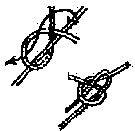
It's perhaps the best way to connect two ropes that there is. It's absolutely secure and jerk-resistant in all materials. It's also remarkably easy to untie after use.
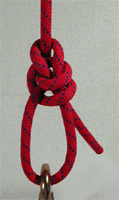
When a rope has to be pulled through water, any knot has a tendency to tighten and jam. In the case of a Bowline, an extra hitch as shown will lessen this tendency.
A weaver frequently has to tie knots and many different ones have been used by him. The one shown here is the one most frequently known by this name: it is the Sheet Bend but tied in a special and rapid manner originally peculiar to the weaver.
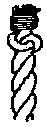
A knot worked in the end of a rope with the unlaid strands. Occasionally used on its own as a Rope End Knot but more often as part of a more complex knot, e.g., the Man Rope Knot, etc. It is the exact opposite of a Crown Knot
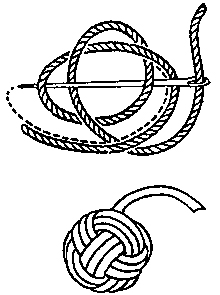
The Turk's Head is, more accurately, a system rather than just a knot, generally tubular in form, decorative and very useful. Basically a binding knot, but can be worked flat for decorative purposes. Can be made with separate strands (Standing Turk's Heads) or with a single, continuous strand (Running Turk's Head).
This is sometimes considered as a Handcuff Knot but is somewhat inferior for this purpose to the knot which usually bears that name. It is a good knot with which to commence a slightly fancy Sheepshank. It is also used as a trick knot (it can be tied in a flash in almost a single movement) and is sometimes called the Conjurer's Knot.
One of the simplest yet most effective of hitches. Used on spars, bales, etc., for commencing a diagonal lashing, and with extra half hitches added, for towing or dragging, etc.
Also called the Tucked Splice. When two ends of small stuff have to be joined together in the middle of a job, such as a serving, a knot might be too bulky. The Tucked Bend bulks less than a Reef Knot and is useful for such purposes.
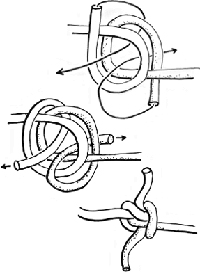
A variation of the Reef Knot in which the ends are on opposite sides. Useless but interesting owing to the legend that it was made by sailors to catch thieves who presumably assumed it to be a Reef Knot.
There are a number of knots which have been given this name from time to time, including the Middleman's Knot, but the one shown here, also known as the Shamrock Knot, appears to have the best claim to the title. It is also known in the Far East where it is often found on Chinese Priest Cords
A loop knot used in climbing and mountaineering and intended primarily for nylon ropes. Usually attached to a karabiner on the waist loop. Named by its inventor, the well known British climber.
This is a variation of the Reef Knot in which an extra turn is taken at the start to help prevent the knot from tending to loosen while being completed. Used by surgeons for tying a ligature and by us for parcels, etc.
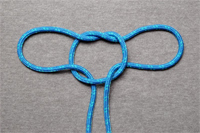
The most useful and practical knot for bending (tying) two ropes together. Note that to be correct the two ends should be on the same side of the knot. If the two ropes differ in thickness, a Double Sheet Bend should be used.
A knot tied in the bight for shortening a rope or taking up the slack, without cutting it. It can also be used to protect a weak, damaged or frayed section of the rope. See also Tom Fool Knot.
A double loop knot that is tied in the bight in which the two loops are splayed. Formerly used at sea for lowering a man from a height, or raising him aloft.
A method of securing a load temporarily and ready for instant casting off, in which a bight is simply held by the tension on the standing part. Not to be confused with a Slipped Hitch.
Draws up without working to form a strong, secure hitch that will not jam. It may be used as a way to tie a smaller rope to a very large rope. (The smaller rope should pull left when tied as shown here.) Push a bight through the final tuck to form a Slipped Sailor's Hitch.