 |
| How To Tie A Rolling Hitch |
 |
| How To Tie A Round Turn And Two Half Hitches |
 |
| How To Tie A Sheepshank |
 |
| How To Tie A Clove Hitch |
 |
| How To Tie A Bowline |
 |
| How To Tie A Sheet Bend |
 | |
| How To Tie A Reef Knot |
The 16 Points Of A Compass The sixteen points of compass are divided into three parts as follows:
(i) Cardinal Points (PRIMARY)
- North
- South
- East
- West
(ii) Half Cardinal Points (TERTIARY)
- North - East
- South - East
- South - West
- North - West
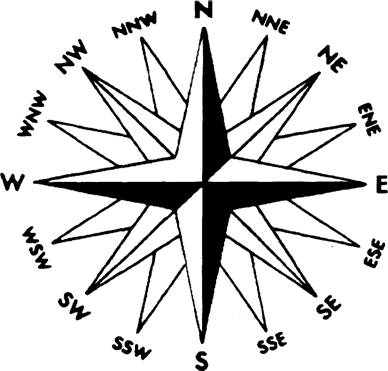
(iii) Three Letter Points (TERTIARY)
- North - North - East
- East - South - East
- East - South - East
- South - South - East
- South - South - West
- West - South - West
- West - North - West
- North - North - West
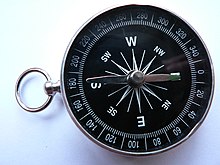 |
| A Compass |
A Compass is a navigational instrument for determining direction relative to the Earth's magnetic poles. It consists of a magnetized pointer (usually marked on the North end) free to align itself with Earth's magnetic field. A compass is any magnetically sensitive device capable of indicating the direction of the magnetic north of a planet's magnetosphere. The face of the compass generally highlights the cardinal points of north, south, east and west. Often, compasses are built as a stand alone sealed instrument with a magnetized bar or needle turning freely upon a pivot, or moving in a fluid, thus able to point in a northerly and southerly direction.
The compass greatly improved the safety and efficiency of travel, especially ocean travel. A compass can be used to calculate heading, used with a sextant to calculate latitude, and with a marine chronometer to calculate longitude. It thus provides a much improved navigational capability that has only been recently supplanted by modern devices such as the Global Positioning System (GPS).
The compass was invented in ancient China around 247BCE, and was used for navigation by the 11th century. The dry compass was invented in medieval Europe around 1300. This was supplanted in the early 20th century by the liquid-filled magnetic compass.
Other, more accurate devices have been invented for determining north that do not depend on the Earth's magnetic field for operation (known in such cases as true north, as opposed to magnetic north). A gyrocompass or astrocompass can be used to find true north, while being unaffected by stray magnetic fields, nearby electrical power circuits or nearby masses of ferrous metals. A recent development is the electronic compass, either a magnetometer or a fibre optic gyrocompass, which detects the magnetic directions without potentially fallible moving parts. A magnetometer frequently appears as an optional subsystem built into hand-held GPS receivers. However, magnetic compasses remain popular, especially in remote areas, as they are relatively inexpensive, durable, and require no power supply.
 |
| For The Head |
- For the Head: Rub the head and face, firmly over several times with the palms and fingers of both hands. Thumb the muscles of the neck and throat.
- For the Chest: From upright position bend to the front, arms stretched downwards, with back of the hands together in front of the knees. Breathe out. Raise the hand gradually over the head and lean back as far as possible, drawing a deep breath through the nose as you do. Lower the arms gradually to the sides, breathing out the word "Thanks" through the mouth. Lastly, bend forward again, breathing out the last bit of breath in you, and saying the number of times you have done it in order to keep count.Repeat this exercise 12 times.
- For the Stomach: Standing upright, send out both arms, fingers extended, straight to the front, then slowly swing round to the right from the hips without moving the feet, and point the right arms as far round behind you as you can, keeping both arms level with, or a little higher than, the shoulders. Then, after a pause, swing slowly round as far as you can to the left. Breathe in when pointing to the left. "Body twisting". Breathe out when pointing to the right. Repeat six times, change the breathing to the other side and repeat six times.
- For the Trunk: This is also called the "Cone Exercise". Standing at "Attention" position, raise both hands, as high as possible over the head, and link fingers. Lean backwards, and then sway the arms very slowly round in the direction of a cone, so that the hands make a wide circle above and around the body, the body turning from the hips, and leaning over one side. Then to the front, then to the other side, and then back. After completing the circle, start in the opposite direction. Repeat six times both ways. Breathe in when leaning backward and breathe out when leaning forward.
- For Lower Body and Back of Legs: Stand with feet slightly apart, touch your head with both hands and look up into the sky, leaning back as far as you can, and then bend forward and downward till your fingers touch your toes, without bending your knees.Repeat 12 times.
- For Legs, Feet and Toes: Stand in 'Attention' position, put the hands on the hips, stand on tip-toe, turn the knees outwards, and bend them slowly down to a squatting position, keeping the heels off the ground the whole time. Then gradually raise the body and come to the first position again. Repeat this 12 times. Breathe in as body rises and breathe out as the body sinks.